Jaw growth: the time window of orthodontics
While growth continues, it can be guided. After that, teeth can only be moved.
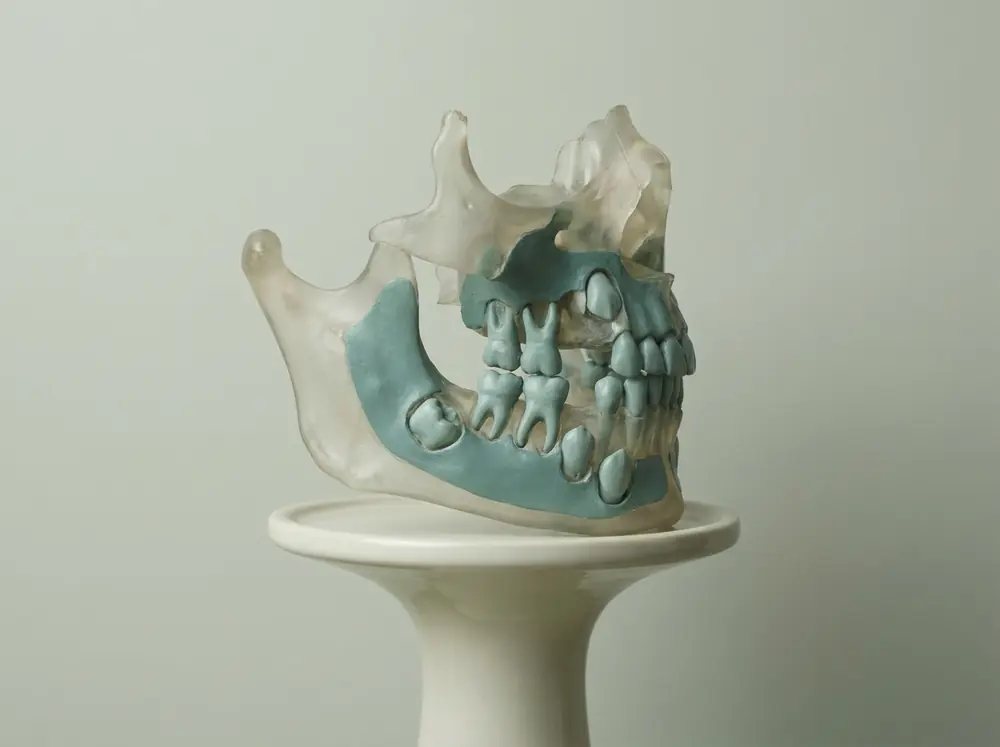
Orthodontics can do two different things: move teeth and guide jaw growth. The first is possible throughout life, the second only while growth continues. Almost the entire schedule of the field follows from this.
How the jaws grow
The upper jaw grows mainly in width – via the palatal suture, which only ossifies after puberty. That is the time window for palatal expansion. The lower jaw grows for longer, with a marked spurt during puberty – in girls around two years earlier than in boys. This spurt is used to guide a receding lower jaw forward.
Why the tongue plays a part
The upper jaw is shaped from the inside by the tongue and from the outside by the cheeks and lips. If the tongue does not rest against the palate – for instance with constant mouth breathing – the counter-pressure is missing and the jaw stays narrow. A high, pointed palate is often the visible result.
When growth ends
That cannot be read off the calendar. The orthodontist estimates it from a lateral X-ray of the skull, sometimes from an X-ray of the hand. Roughly: in girls at about 16 to 18, in boys at 18 to 21 – with considerable variation from case to case. Residual growth of the lower jaw into the third decade of life has been described.
What follows from this
Growth-dependent treatments – underbite, palatal expansion, guiding the lower jaw forward – have a window that closes. That is why these findings are not put on hold. All other corrections are in no hurry.
Key facts at a glance
- Moving teeth is possible throughout life. Guiding jaw growth only while growth continues.
- The upper jaw grows in width via the palatal suture – it ossifies after puberty.
- The lower jaw has a growth spurt during puberty, in girls around two years earlier than in boys.
- The end of growth is estimated from an X-ray, not from age.
Answered briefly
Frequently asked questions
Roughly at 16 to 18 in girls and 18 to 21 in boys – individually very different. The orthodontist estimates it from an X-ray, not from the date of birth.
Often because the tongue has not shaped it from the inside – typical with constant mouth breathing, for example due to enlarged adenoids. A high, pointed palate and a crossbite are the common consequences.
Guided, yes; created, no. An appliance can influence the direction of existing growth and steer the lower jaw into a more favourable position. It cannot make a jaw grow that is not growing.
Yes, lifelong. Late crowding of the lower incisors between 20 and 40 is widespread and also occurs without any previous treatment – one reason why retainers are thought of long-term today.