Palatal expansion: widening the upper jaw
One millimetre a week – and a window of time that closes.
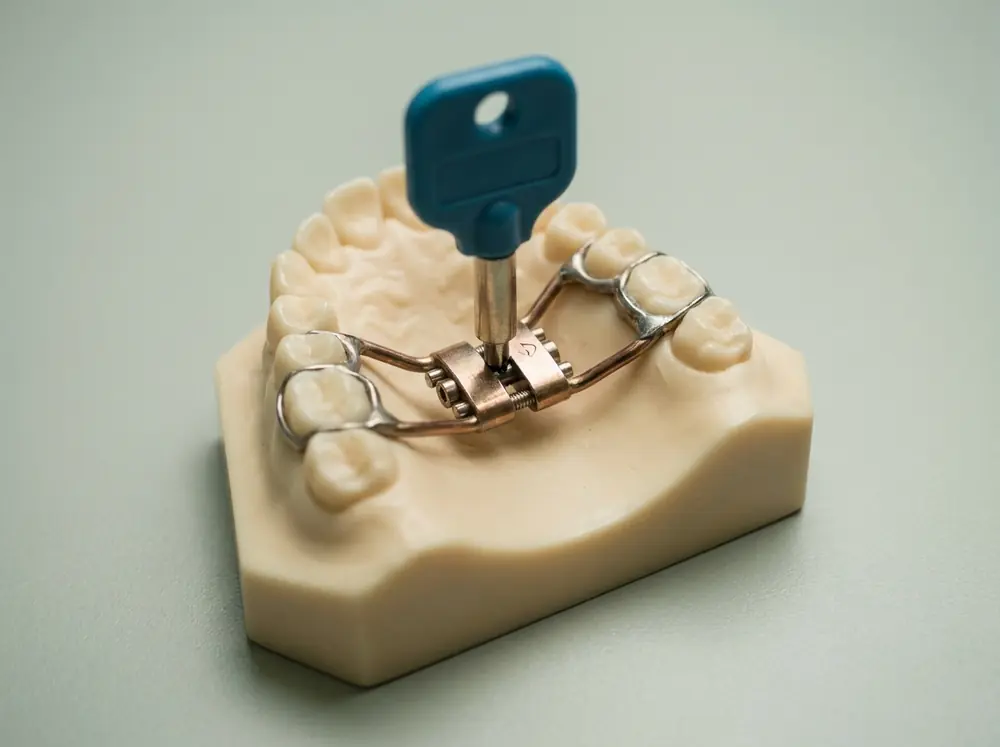
The upper jaw consists of two halves joined in the middle by the palatal suture. In children and adolescents this suture has not yet ossified. That is exactly what palatal expansion makes use of: an appliance pushes the halves apart, and the gap fills with new bone.
When it is indicated
For an upper jaw that is too narrow – recognisable by a crossbite, by lack of space or by a high, pointed palate. Behind this there is often constant mouth breathing: when the tongue does not rest against the palate, it does not shape it from within.
The procedure
The appliance is attached to the upper back teeth. In the middle sits a screw that is turned a little every day at home – usually a quarter to half a turn, as instructed by the practice. The active phase lasts two to four weeks. After that, the appliance stays in place for about another six months so that the new bone hardens.
What parents can expect
A feeling of pressure behind the nose when turning, sometimes briefly wobbly teeth. And a visible gap between the upper front teeth – it is the sign that it is working, and it closes by itself within a few weeks. Many children also report breathing better through the nose.
The window of time
After puberty the palatal suture fuses. Then widening is only possible with surgical support. That is one of the reasons why a crossbite is not left to wait.
The essentials at a glance
- The palatal suture is still open in children. An appliance pushes the halves of the upper jaw apart, and the gap fills with bone.
- Indicated for an upper jaw that is too narrow: crossbite, lack of space, a high pointed palate.
- Active phase two to four weeks, after which the appliance stays in place for six months while the bone hardens.
- After puberty the suture has fused – then it only works with surgical support.
Answered briefly
Frequently asked questions
When the screw is turned, there is a feeling of pressure behind the nose that subsides after minutes. Pain in the true sense is rare. If a child complains more strongly, the screw can be turned more slowly – ask at the practice.
It is intended and is the visible sign that the suture is opening. It closes by itself within a few weeks after the end of the active phase, because the fibres between the teeth pull the crowns back together.
Usually the parents, following precise instructions and mostly with a key handed out by the practice. What matters is keeping to the schedule: every day at the same time, and no catching up if a day was missed – ask instead.
In many children, yes, because widening the upper jaw also broadens the floor of the nose. That does not make it a therapy for nasal breathing – if there is a cause in the throat, it needs to be investigated as well.