Functional orthodontics: activator, bionator and more
Appliances that do not push teeth but invite growth.
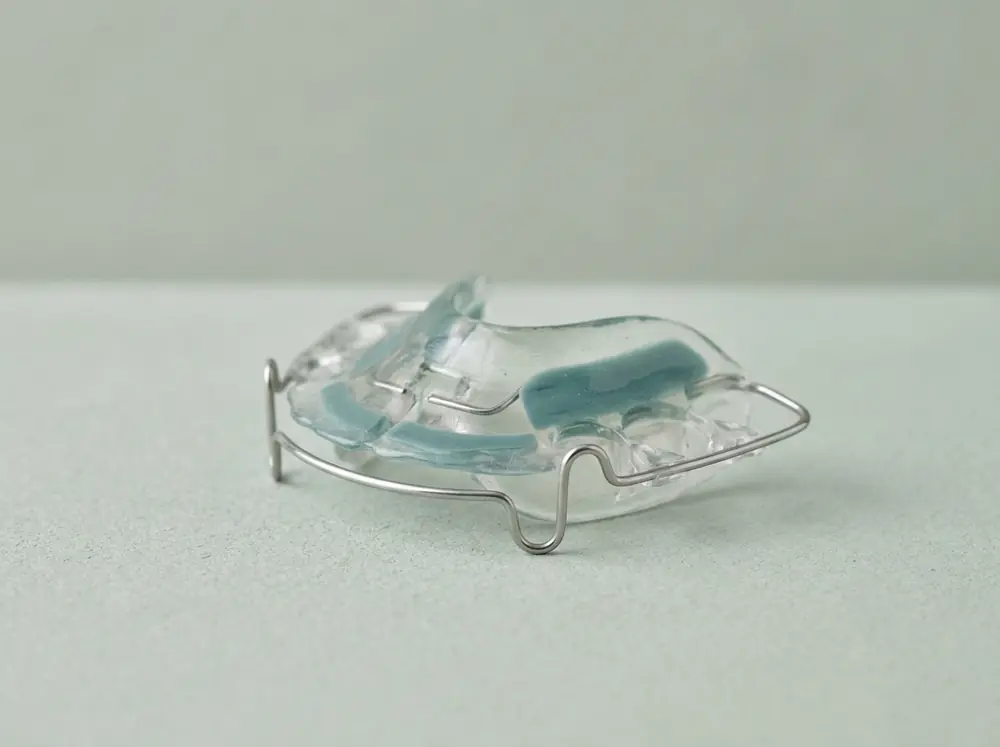
Functional orthodontic appliances work differently from an ordinary brace. They do not push against teeth but hold the lower jaw in a new position. The muscles work against this, and that stimulus guides growth. That is why they only work while growth continues.
The well-known types
The activator is the classic: an acrylic block that connects both jaws and guides the lower jaw forward. The bionator is the slimmer variant with more freedom of movement for the tongue. The function regulator keeps the cheeks and lips away from the dental arch so that it can develop. The Herbst appliance is fixed and holds the lower jaw permanently forward – it needs no cooperation. The headgear works from the outside and slows the forward growth of the upper jaw.
What they are used for
Above all for a receding lower jaw with an increased overbite – the most common finding in the mixed dentition of all. As a rule they do not replace the later fixed brace but create the conditions for it.
The wear time
This is where everything is decided. The removable appliances need 14 to 16 hours a day – nights plus several hours. That is a lot, and many children do not manage it. The fixed Herbst appliance is designed for exactly this case: it works whether you want it to or not.
Key facts at a glance
- Functional orthodontic appliances do not push teeth; they hold the lower jaw in a new position and thus guide growth.
- They only work during growth. Once it is complete, they have no effect.
- The activator, bionator, function regulator and headgear are removable. The Herbst appliance is fixed and needs no cooperation.
- 14 to 16 hours of wear a day – that is what decides success.
Answered briefly
Frequently asked questions
Because it does not act on individual teeth but sets both jaws in relation to each other. That takes bulk. It is almost always unfamiliar during the first nights; after one to two weeks it is usually no longer an issue.
Only to a limited extent with the removable appliances – which is why they are worn at night and in the evening hours. The fixed Herbst appliance leaves speech largely unaffected.
An appliance that is supported at the neck or head via an external part and slows the forward growth of the upper jaw. It is used less often today than in the past, because it is visible and demands a lot of cooperation – but for certain findings it remains the right solution.
Usually not. It aligns the jaws with each other; the exact tooth position comes afterwards. Both together make up the total duration – the treatment plan should state this from the outset.