White spots after the brace: where they come from
The most common lasting consequence of brace treatment – and the most avoidable one.
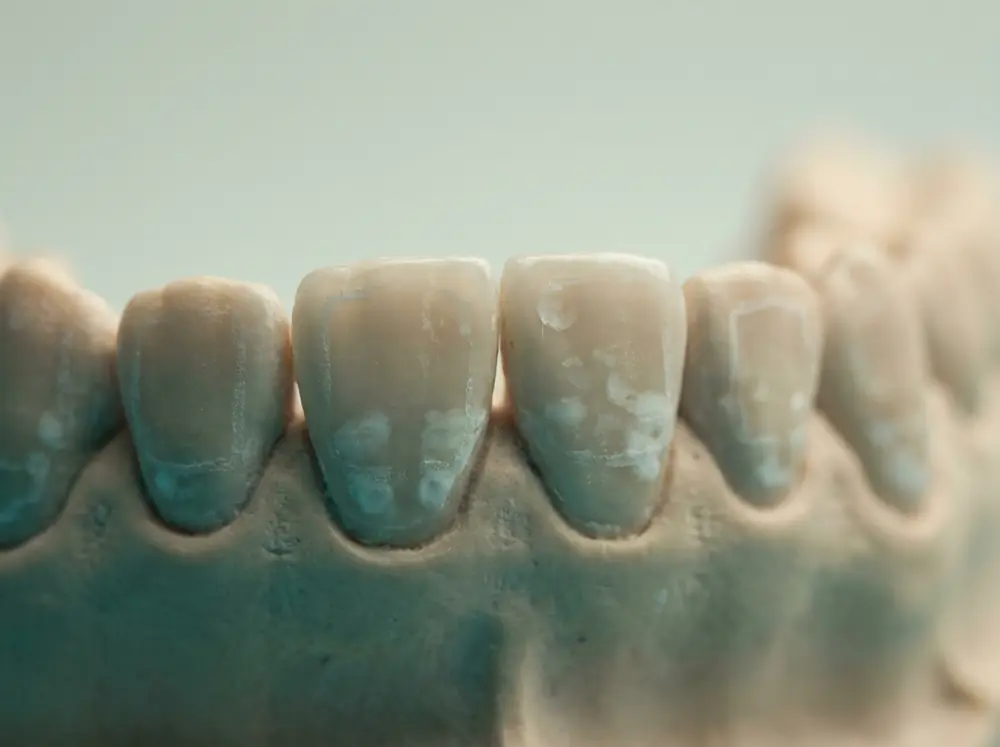
When plaque is left sitting around a bracket, the bacteria in it produce acids. The enamel loses mineral, becomes porous and scatters light differently – it appears chalky white. The technical term is initial caries or white spot lesion. When the brace is removed, the spot comes to light: a pale frame where the bracket sat.
Why this is so common
Brackets and archwire create niches that were not there before, and they sit exactly where the brush struggles to reach. Anyone whose teeth were clean without effort before underestimates this – the usual brushing routine is no longer enough.
What helps while the brace is on
- brush after every meal, for at least three minutes, going around each bracket individually
- interdental brushes for under the archwire – dental floss fails there
- a toothpaste with increased fluoride content, plus a fluoride gel once a week
- less sugar in between, especially fewer sugary drinks
- regular check-ups with your family dentist, not only with the orthodontist
What can still be treated
Caught early, mineral can be redeposited – with fluoride and mineral-containing preparations over months. If the spot remains, there is caries infiltration: a thin-flowing resin penetrates the porous enamel and matches its light refraction, so that the spot visually recedes. Neither is a guarantee. A spot that stays, stays visible.
The essentials at a glance
- White spots are decalcified enamel – caused by plaque left sitting around the bracket.
- They only show when the brace comes off, and then they remain visible.
- Prevention is only possible during the treatment: brush after every meal, interdental brushes, fluoride, less sugar.
- Caught early, mineral can be redeposited. Remaining spots can be visually blended in with caries infiltration.
Answered briefly
Frequently asked questions
No. Enamel does not form anew. What is possible is the redeposition of mineral into the porous area – this reduces the contrast but rarely makes the spot disappear completely.
Bleaching lightens the healthy enamel as well – the difference remains or even becomes more pronounced. Caries infiltration is the approach that targets the spot directly.
They are the preliminary stage: mineral has left the enamel, but the surface is still intact. If it progresses, the surface breaks down – then it is tooth decay and must be filled. That is exactly why early detection counts.
Hardly. The aligner is taken out for brushing, so the tooth surface remains freely accessible. That is the greatest practical advantage of aligner treatment.