Invisible brace: aligners and what they can do
Barely visible, removable – and not suitable for every case.
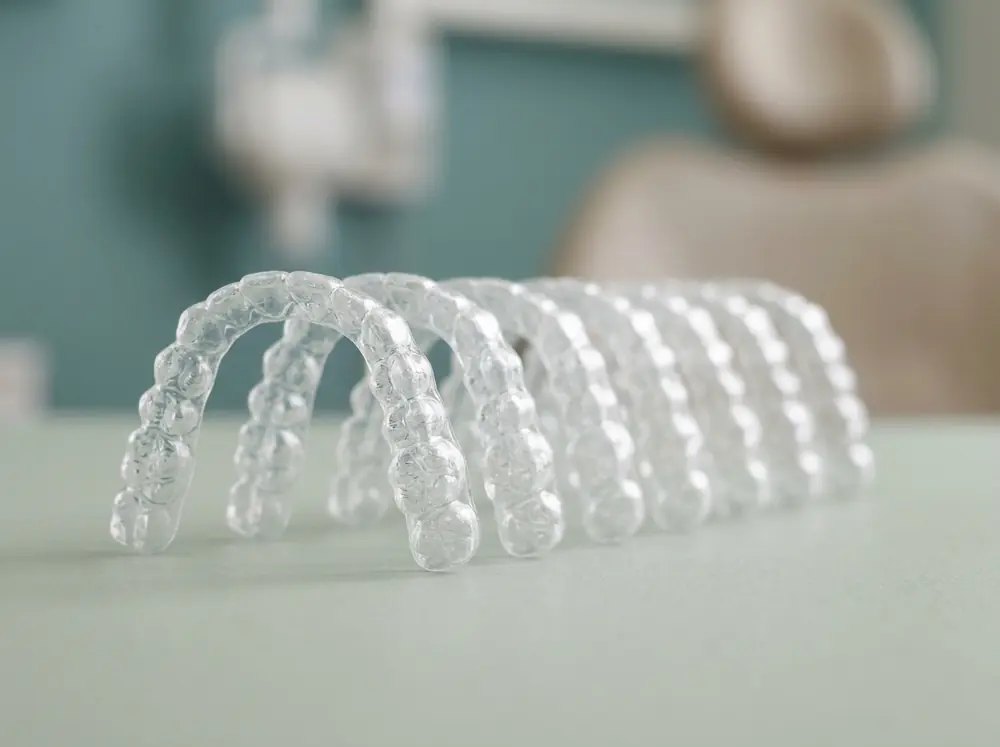
Aligners are clear plastic trays that are pulled over the row of teeth. Each tray is shaped minimally differently from the tooth position that currently exists; this difference creates the pressure. Every one to two weeks, you change to the next one.
What speaks for them
They are hardly noticeable in conversation. They are taken out for eating, so there are no restrictions on food. And tooth care remains possible unchanged – that is the biggest practical advantage over the fixed brace, because the white spots caused by plaque left in place do not develop here.
Where the limits lie
Trays enclose the tooth crown; they do not grip it. Rotating teeth, moving them vertically or bodily closing larger gaps works less well for them than for a fixed brace. Small bonded plastic grips – attachments – extend their scope but do not remove the limit.
Compliance decides
22 hours a day. That is not a recommendation but the assumption on which the planning is calculated. Anyone who regularly leaves the tray out for longer shifts the whole schedule – and at some point the next tray no longer fits.
About the brand names
There are several providers of aligner systems; one well-known name often stands for the whole method. What matters is not the system but who does the planning. The professional community advises against aligner offers without an orthodontic examination, where the impression is taken at home: without an X-ray and findings, it cannot be judged whether a tooth movement is justifiable at all.
The essentials at a glance
- Aligners are clear trays that are changed every one to two weeks. Each is shaped minimally differently from the current state.
- 22 hours a day is the assumption, not the recommendation. Below that, the planning does not work out.
- Rotations, vertical movements and closing larger gaps work less well for them than for a fixed brace.
- The professional community advises against offers without an examination and X-ray, with impressions taken at home.
Answered briefly
Frequently asked questions
Barely visible is more accurate. Up close and in certain light you can see the aligner, especially the bonded attachments. In conversation, most people do not notice them.
For mild to moderate corrections, above all in the front area: crowding, gaps, tilted teeth. Pronounced bite misalignments, severe rotations and vertical movements are their weak point.
They are a private service, even for children and adolescents with insurance coverage – the insurance pays for the standard care, not for the aligner. The amount depends on the number of aligners and is set out in the cost plan before treatment begins.
They are taken out for eating; afterwards the teeth are brushed and the aligner is put back in. With the aligner in, only water may be drunk – sugary or hot drinks damage the tooth underneath or deform the plastic.