The retainer: why the brace is not the end of it
The teeth are straight. And without help they would drift back again.
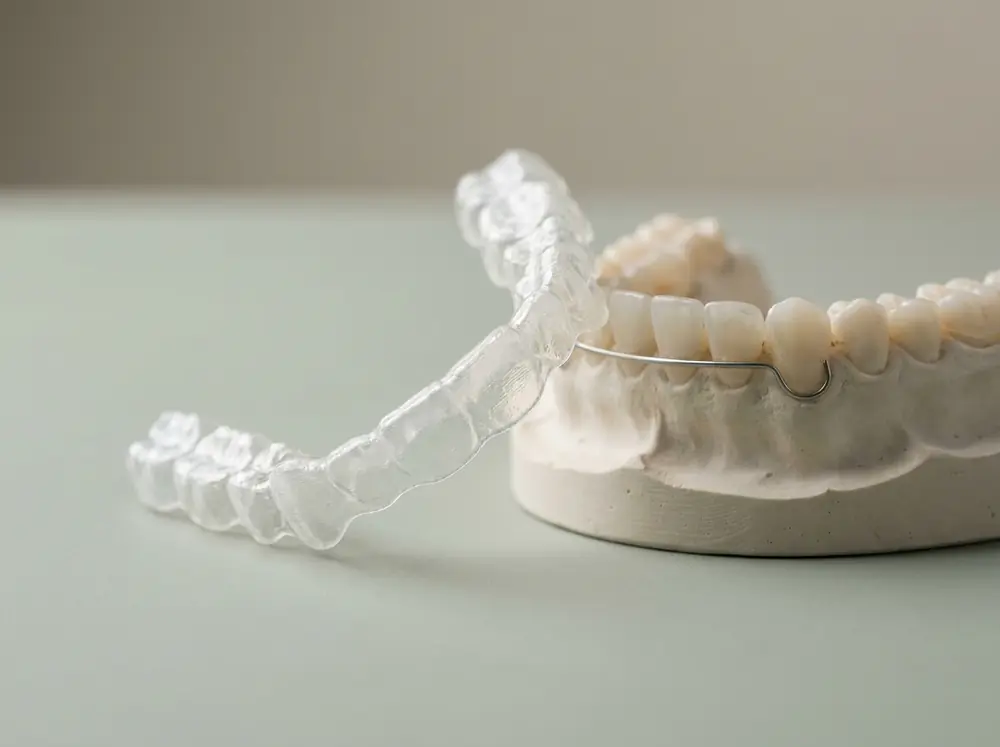
After the brace comes off, the teeth stand in a new place. But the fibers of the periodontium that surround them are stretched and pull back. The bone needs months to remodel; the connective tissue remembers for years. Without something to hold them, the teeth drift back – that is not a rare complication but the normal course.
The two designs
The fixed retainer is a thin wire bonded to the inside of the front teeth. It works around the clock without you having to think about it. In return, it demands careful cleaning with floss or small brushes, because tartar forms underneath it.
The removable tray is worn at night. It is easier to clean, but only works while it is in place – and thus again depends on compliance.
For how long
Permanently for the first one to two years, then increasingly reduced – that is the classic plan. Today, however, the professional community assumes that permanent stabilization is necessary if the result is to last permanently. A fixed retainer that simply stays in place is therefore often the most practical solution.
What to watch out for
A loose retainer wire is a case for a prompt check-up: if it is still attached to only one tooth, it can move that tooth individually – in the wrong direction. And a lost tray should be replaced within a few days, not after months.
The essentials at a glance
- Without a retainer, the teeth drift back. That is the normal course, not a rare complication.
- The fixed retainer is a wire bonded to the inside that works around the clock – and demands careful cleaning.
- The removable tray is worn at night and again depends on compliance.
- A loose retainer wire can move individual teeth in the wrong direction – have it checked promptly.
Answered briefly
Frequently asked questions
Continuously for the first one to two years. After that, experts today assume that permanent stabilisation is necessary if the result is to last. A fixed retainer therefore often simply stays in place.
Go to the practice promptly. A wire that is only attached to some of the teeth can move individual ones – in an uncontrolled way. That is worse than no retainer at all.
Not the wire itself, but the plaque that collects on it. Tartar forms more easily under the retainer. Anyone who keeps it clean there with floss and interdental brushes has no disadvantage; anyone who neglects it gets gum inflammation in exactly that spot.
Hardly in the area the retainer holds. The back teeth, however, are not secured, and late crowding of the lower front teeth also occurs without previous treatment. That is why the retainer belongs in the regular dental check-up.