The fixed brace: brackets, archwire and what they achieve
The design that can move every tooth in every direction.
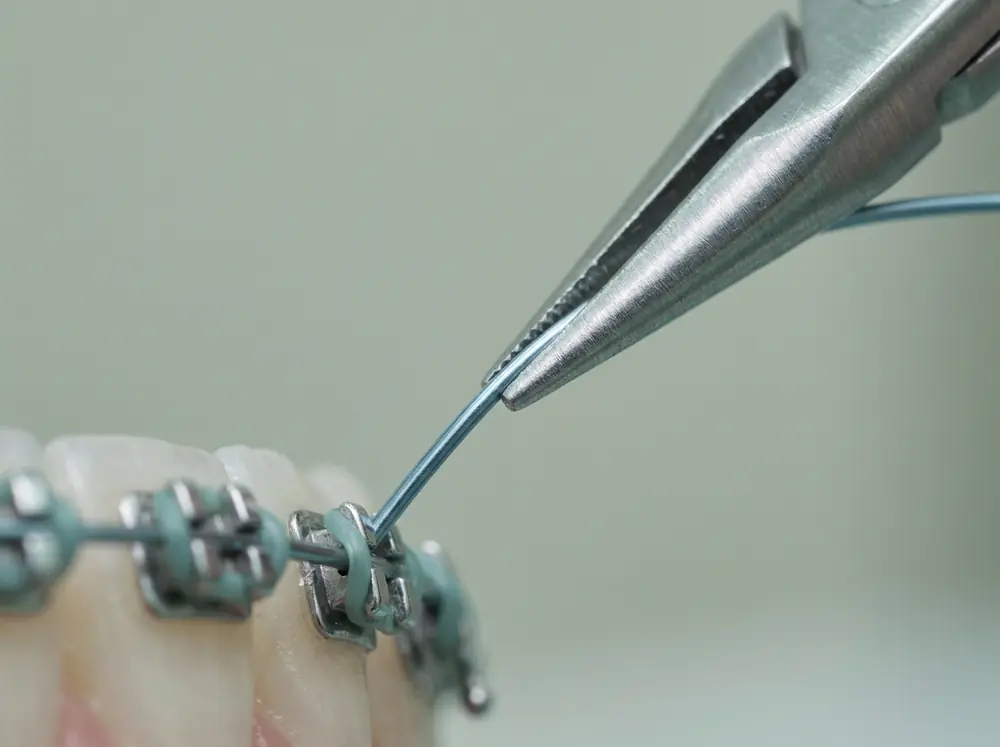
With a fixed brace, a small plate is bonded to each tooth – a bracket. Through the brackets runs an archwire made of an alloy that strives to return to its original shape. It is exactly this striving back that moves the teeth: continuously, gently and in every direction.
Why it is often the only option
Only the fixed brace can tip each individual tooth, rotate it, move it vertically and change the position of its root. Removable appliances and aligners can do this only to a limited extent. With pronounced malocclusions, there is therefore no way around it.
The types of brackets
Metal brackets are the standard option: small, sturdy, inexpensive, visible. Ceramic brackets are tooth-colored and therefore less conspicuous, but larger and more prone to breakage – they are a privately paid extra. Self-ligating brackets hold the archwire without elastics; whether they really shorten treatment is a matter of professional debate.
Care plays a deciding role
Brackets and archwire create niches where plaque persists. If it stays there, the enamel decalcifies – after the brace comes off, white spots remain visible, permanently. This is the most common avoidable consequence of brace treatment. What is needed: a soft brush, interdental brushes for under the archwire, and patience after every meal.
The essentials at a glance
- A bracket is bonded to each tooth; an archwire in the brackets strives back to its shape and moves the teeth.
- Only the fixed brace can move every tooth in all directions – with pronounced malocclusions there is no way around it.
- Metal brackets are the standard option. Ceramic brackets are less conspicuous, larger, more prone to breakage and privately paid.
- White spots caused by plaque left in place remain permanently visible after the brace comes off. They are the most common avoidable consequence.
Answered briefly
Frequently asked questions
As a rule one to three years, depending on the extent of the correction. This is followed by the retainer for stabilisation.
The bonding itself does not. In the first days and after each adjustment the teeth are sensitive to pressure, especially when biting. At first the brackets can chafe against the cheek and lip – there is protective wax for that. Both subside.
Do not reattach it yourself. If it is still sitting loosely on the archwire, leave it there and call the practice; if it has fallen off, keep it. A single missing bracket is not an emergency, but it should be rebonded promptly, otherwise the tooth no longer moves along.
Don't bite into anything hard – cut apples, carrots and bread crusts into small pieces first. Nothing sticky like caramel or chewing gum. And as few sweet things as possible between meals, because cleaning is already more difficult.