Aligner or fixed brace: which is better for what
The most common question in consultations – and the answer does not hinge on taste.
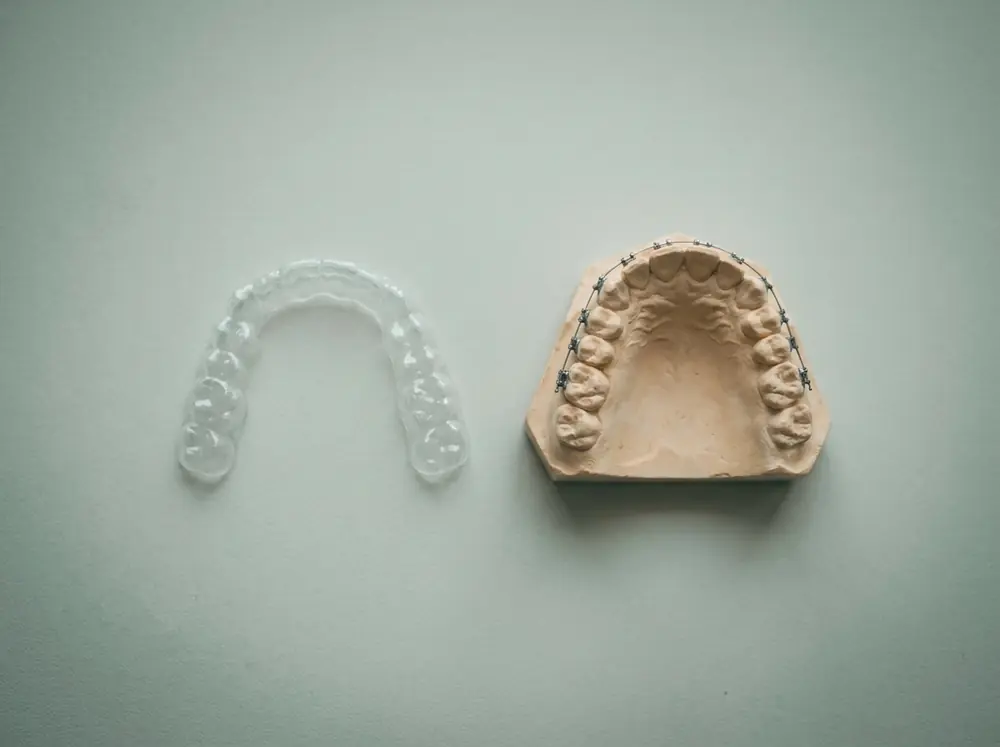
Both move teeth through constant pressure. The difference lies in how they take hold: brackets are bonded to the tooth and can tilt it, rotate it, raise it and change the position of its root. An aligner encloses the crown from the outside – it pushes, it does not grip.
Where the fixed brace is ahead
With severe rotations of individual teeth. With vertical movements, for instance with a deep bite. With bodily closure of larger gaps, where the root has to move along. And whenever compliance cannot reliably be expected – the fixed brace works whether you want it to or not.
Where aligners are ahead
With mild to moderate crowding, small gaps and relapses after an earlier treatment. And in one respect that is often underestimated: dental care. White spots from plaque left behind – the most common lasting consequence of a brace treatment – practically do not occur with aligners, because you brush as you always have.
What decides it
The findings, then compliance, then visibility and costs – in that order. Anyone who wants an aligner although the findings call for a fixed brace prolongs the treatment or gets a poorer result. Anyone who cannot manage 22 hours a day is better served with brackets.
And the third way
Invisible can also be fixed: lingually bonded brackets sit on the inside and can do everything that brackets bonded on the outside can. They are more expensive and take some getting used to in the first weeks – the tongue needs time.
The essentials at a glance
- Brackets take hold of the tooth, aligners enclose it. The whole difference follows from that.
- Fixed brace: severe rotations, vertical movements, larger gap closures – and when compliance is uncertain.
- Aligners: mild to moderate crowding, small gaps, relapses – and considerably better dental care.
- The order of the decision: findings, compliance, only then visibility and price.
Answered briefly
Frequently asked questions
Not fundamentally. With small corrections they can be faster because there is less to move. With the same findings there is no reliable time advantage – the bone remodels at the same speed in both cases.
As a rule yes, and for children and adolescents with insurance coverage always: the insurance pays for the standard care, the aligner is a private additional service. For adults both options are paid privately; there the difference depends on the scope.
Yes, that happens – for instance when aligners reach a limit or the wearing time is not achieved. A switch costs time and usually money as well; it should therefore already be discussed as a possibility during planning.
They exist: first a fixed brace for the difficult movements, then aligners for the fine-tuning. Or brackets on one jaw only. Such approaches are not unusual and are often the most sensible solution.